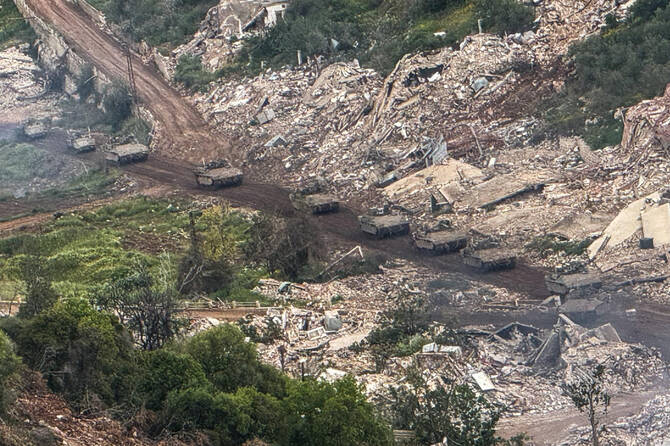
The Vatican newspaper, L'Osservatore Romano, condemned the Israeli army’s destruction of the Holy Savior Christian School in Yaroun, Lebanon, in an article published on May 04, 2026. The Vatican newspaper decried the Israeli army’s attack on a Catholic school building in Yaroun. Federico Piana reported in the newspaper's May 2 edition that Israeli bulldozers tore down the Holy Savior Christian School, located in the Bint Jbeil district, which also housed nuns' living quarters. Piana stated, "In the last few hours, Israeli bulldozers have torn down the Holy Savior Christian School...Yet, those mechanical shovels—instruments of destruction—operated within a ghost village." He added, "And this 'cleanup' always follows the same script: the village populations are ordered to evacuate, and then the area is subjected to bombing." The report noted the significant impact of the Israeli military's actions on civilian infrastructure and religious institutions in the region.
Details of the Destruction
The Holy Savior Christian School building in Yaroun also served as living quarters for nuns, making its destruction particularly poignant for the local community and religious orders. Israeli forces had previously razed part of Yaroun to the ground during the 2024 war, an event that had already severely impacted the village's residents. The destruction of the school, located in the Bint Jbeil district, was part of broader operations in the area that have drawn international scrutiny. The school's dual function as both an educational institution and a residence for religious personnel was noted in reports concerning the incident, showing the multifaceted loss represented by its demolition. The previous razing of parts of the village had displaced its population before the school's destruction, leaving it largely uninhabited. The extent of the damage reported by L'Osservatore Romano paints a picture of full devastation in the affected areas.
Context and Wider Impact
Yaroun had been uninhabited and lay in ruins since the 2024 conflict against Hezbollah, which had compelled its population to abandon their homes and lands that same year. Israel had partially razed Yaroun to the ground during the 2024 war, further contributing to its desolate state. The population of Yaroun had already been forced to abandon their homes and lands in 2024, long before the latest incident involving the school. Federico Piana, writing in L'Osservatore Romano, described the scene, stating, "In the last few hours, Israeli bulldozers have torn down the Holy Savior Christian School in the village of Yaroun—located in the Bint Jbeil district—which also housed the living quarters of the nuns dedicated to the spiritual and cultural growth of hundreds of students. Yet, those mechanical shovels—instruments of destruction—operated within a ghost village." This vivid description emphasizes the emptiness of the village at the time of the school's demolition.
Piana further detailed the pattern of destruction, observing, "And this 'cleanup' always follows the same script: the village populations are ordered to evacuate, and then the area is subjected to bombing. Only subsequently do the bulldozers move in, leveling every house—leveling everything in their path. Every historical memory is being erased. All that remains is a spectral, anonymous landscape—a place without a past." According to Piana, there are already more than 50 such villages along the "yellow line," with many awaiting demolition or already razed. All of these villages are described as empty, reflecting the broader impact of the ongoing conflict on civilian infrastructure and communities, and the systematic erasure of their historical and cultural footprints.
Reactions and Denials
The Times of Israel reported that the Israeli military acknowledged causing some damage to a Catholic convent in southern Lebanon. The military stated that this damage occurred while its forces were working to destroy Hezbollah infrastructure in the area. The Israeli military, however, denied that the site had been "demolished" with bulldozers, contradicting reports of extensive destruction from the Vatican newspaper. This denial notes a significant discrepancy in accounts of the incident. A resident from one of the three remaining Christian villages in the region spoke to L’Osservatore Romano, providing a local perspective on the events unfolding in the area and offering a firsthand account of the challenges faced by these communities.