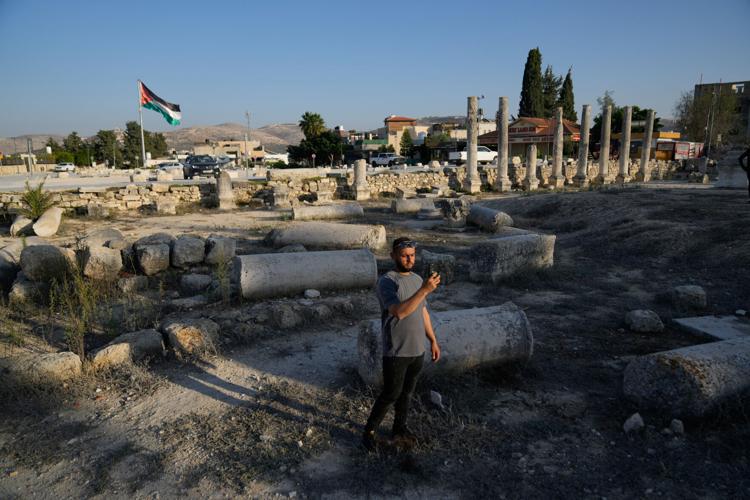
A United Nations committee voted Friday to inscribe a major archaeological site in the West Bank and a set of castles in southern Lebanon as World Heritage sites. The decision by UNESCO's World Heritage Committee added the small West Bank town of Sebastia and five castles in Lebanon’s Mount Amel area to the prestigious list. This significant decision was made during a U.N. Educational, Scientific and Cultural Organization (UNESCO) meeting held in South Korea, where the committee deliberated on numerous nominations from around the globe.
Sebastia, located near Nablus in the West Bank, includes ruins from the Roman and Hellenistic periods and is considered a significant archaeological site. It is believed to be the ancient city of Samaria, the capital of the Kingdom of Israel. The site's rich historical tapestry is further enhanced by Christian and Islamic traditions, which hold that John the Baptist was buried there. This belief adds another profound layer of historical and spiritual relevance to the site, which spans various historical periods. The Lebanese nominations encompass five castles within the Mount Amel region, including Beaufort Castle near the Litani River, which holds historical significance for Lebanon.
Historical Significance of Sebastia
Scholars identify Sebastia as the ancient city of Samaria, which served as the capital of the biblical Kingdom of Israel. The site, situated near Nablus in the West Bank, encompasses archaeological remains that span multiple historical eras. These include artifacts and structures from the Iron Age, Roman, Byzantine, and Islamic periods, reflecting a long and complex history of human settlement and cultural layering. The area's rich archaeological record offers insights into various civilizations that have occupied the region over millennia, providing invaluable data for understanding the historical development of the Levant. The continuous occupation and transformation of Sebastia over thousands of years show its exceptional universal value.
The Palestinian delegation to UNESCO first submitted Sebastia's nomination for World Heritage status in 2012. This initial submission began the formal process for the site to be considered for inscription on the prestigious list. The nomination noted Sebastia's exceptional universal value, based on its historical and archaeological importance as a continuously inhabited and significant urban center throughout different historical epochs. The decision by the UNESCO World Heritage Committee to inscribe Sebastia acknowledges its profound historical and cultural contributions, recognizing its global importance for humanity's shared heritage. This inscription provides Sebastia with enhanced protection under international conventions and promotes its conservation for future generations.
Lebanese Castles Heritage
The five castles located in Lebanon's Mount Amel region are recognized for their layered architectural heritage, which incorporates Crusader, Ayyubid, Mamluk, and local influences. These structures represent a complex history of construction and modification across different eras, reflecting the successive powers that held sway over the area. Their inscription on the World Heritage list acknowledges their significant historical and architectural value as a collection of sites demonstrating centuries of regional development and cultural exchange. Each castle tells a story of strategic importance and cultural synthesis, serving as tangible evidence of the diverse historical forces that shaped the region. The intricate stonework and defensive designs offer insights into medieval military architecture and the evolution of fortress construction in the Middle East.
Separately, the UNESCO committee on Wednesday also placed another Lebanese site, the ancient Phoenician city of Tyre, on the list of world heritage sites in danger. This decision notes concerns regarding the preservation and integrity of Tyre, a site already recognized for its outstanding universal value. The status change for Tyre shows growing international worries about various heritage locations in the Middle East, particularly those facing threats from conflict, neglect, or unsustainable development. The international community, through UNESCO, aims to provide additional support and monitoring to ensure the long-term survival of such vulnerable sites.
Reactions and Objections
Israel had previously urged the committee to reject the bids for both the West Bank and Lebanese sites. This move follows Israel's withdrawal from the United Nations Educational, Scientific and Cultural Organization (UNESCO) in 2019. The country's departure from the international body was influenced by what it described as anti-Israel bias in various UNESCO resolutions. These objections are part of a broader diplomatic context surrounding heritage designations in the region, where cultural sites often become focal points for political disagreements. Despite these objections, the UNESCO World Heritage Committee proceeded with its decision, emphasizing the cultural and historical merits of the nominated sites. The decisions on Sebastia and the Lebanese castles were made by the World Heritage Committee on July 24, 2026.
International Diplomacy and History
The decision to inscribe the sites was made at a U.N. Educational, Scientific and Cultural Organization (UNESCO) meeting held in South Korea. Regarding Sebastia, the site holds significant religious importance for both Christian and Islamic traditions. According to these traditions, John the Baptist was buried in Sebastia. This belief adds another layer of historical and spiritual relevance to the archaeological site, which spans various historical periods including Roman and Hellenistic, and is identified as the ancient city of Samaria. The inscription by UNESCO acknowledges this profound historical and cultural significance, despite prior objections raised by Israel. The committee's role is to identify, protect, and preserve cultural and natural heritage around the world considered to be of outstanding value to humanity, a mandate it exercised in recognizing the unique attributes of both Sebastia and the Lebanese castles.