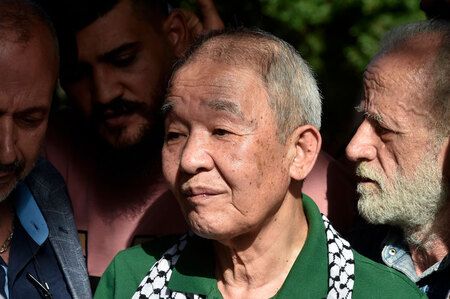
Kozo Okamoto, a former member of the Japanese Red Army who was wanted for his role in a 1972 airport attack, has died in the Lebanese capital of Beirut at the age of 78. His death was announced by the Popular Front for the Liberation of Palestine (PFLP), though the group did not disclose the cause. The PFLP stated that it "mourns his death, calling Okamoto a fighter who made enormous sacrifices for the cause of Palestine." Okamoto had resided in Lebanon for decades after his release from an Israeli prison.
The 1972 Lod Airport Attack
Kozo Okamoto was on an international wanted list as a perpetrator of a deadly shooting attack on an Israeli international airport in 1972. The attack at Lod Airport, now known as Ben Gurion Airport, resulted in the deaths of 26 people and injuries to 80 others. Okamoto, along with two other members of the Japanese Red Army, used automatic weapons and grenades in the assault. The two other attackers died during the incident. Okamoto was the sole survivor among the assailants.
The 1972 attack remains one of the most significant acts of international terrorism attributed to the Japanese Red Army. Its impact resonated globally, noting the transnational nature of militant groups and their collaboration across different regions. The high number of casualties showed the brutality of the assault and its devastating consequences for civilians. The attack specifically targeted an Israeli airport, a symbol of the state, causing widespread shock and condemnation. The use of automatic weapons and grenades indicated a premeditated and highly violent operation.
Okamoto had left Japan in February 1972, seeking a base for his activities with the Japanese Red Army. The group, a militant organization, had established connections with other international revolutionary movements, including the Popular Front for the Liberation of Palestine (PFLP). The Lod Airport attack was carried out on behalf of the PFLP. Israeli authorities captured Okamoto immediately after the attack. He was subsequently tried and sentenced to life imprisonment in Israel for his role in the massacre. His capture and trial brought international attention to the Japanese Red Army's activities and their coordination with Palestinian militant groups. The life sentence reflected the gravity of the crimes committed during the airport assault.
Life in Exile and PFLP Ties
Kozo Okamoto joined an extremist group as a student at Kagoshima University before becoming involved with the Popular Front for the Liberation of Palestine (PFLP). His early radicalization during his university years set him on a path towards militant activism. The PFLP provided protection to Okamoto throughout his time in exile, having welcomed him as a figure who had made significant contributions to their cause. The group stated that it "mourns his death, calling Okamoto a fighter who made enormous sacrifices for the cause of Palestine." This long-standing protection by the PFLP allowed Okamoto to live in Lebanon for decades, despite being an internationally wanted individual. His involvement with radical movements mirrored that of his older brother. Takeshi Okamoto was a member of the group responsible for hijacking the Japan Airlines “Yodo” jet in 1970. Takeshi Okamoto is said to have died in North Korea. The actions of both brothers noted a family connection to radical Japanese militant groups during that era.
Okamoto's release from Israeli prison in 1985 was part of a prisoner exchange. He was among 1,150 prisoners released by Israel in exchange for three Israeli soldiers held by the Popular Front for the Liberation of Palestine – General Command (PFLP-GC). This exchange, known as the Jibril Agreement, allowed him to relocate to Lebanon, where he was granted political asylum. The Lebanese government's decision to grant him asylum was controversial, given his international wanted status. He continued to be a symbol for some Palestinian factions, who viewed him as a hero for his actions. His presence in Lebanon showed the complex political landscape of the region and the sanctuary it sometimes provided to individuals involved in international conflicts.
Mourning and Legacy
The Popular Front for the Liberation of Palestine (PFLP) announced the death of Kozo Okamoto. A senior PFLP member stated that Okamoto died around noon Thursday local time, attributing his passing to poor health associated with old age. His body is scheduled to be buried in the vicinity of Beirut. The PFLP issued a statement expressing its sorrow, declaring that it "mourns his death, calling Okamoto a fighter who made enormous sacrifices for the cause of Palestine." This statement reiterated the group's long-standing support for Okamoto, who had resided in Lebanon under their protection for decades following his release from an Israeli prison. The PFLP's public mourning reflects their continued ideological alignment with Okamoto's actions and their view of him as a dedicated combatant for their cause. His burial near Beirut signifies the enduring connection he maintained with the region and the groups that supported him.
Okamoto's death closes a chapter on one of the most notorious figures associated with the Japanese Red Army and its international operations. Despite being wanted by Japan and other nations, he lived out his final decades in Lebanon, a testament to the political asylum he received. His legacy remains deeply divisive, seen by some as a terrorist responsible for mass murder, and by others, particularly within certain Palestinian factions, as a revolutionary fighter. The circumstances of his life, from his radicalization at Kagoshima University to his involvement in the Lod Airport attack and subsequent exile, highlight the intricate web of international militancy that characterized the late 20th century.