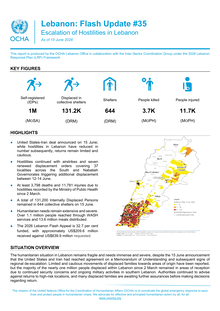
A United States-Iran deal was announced on June 15, 2026, leading to a reduction in hostilities in Lebanon. Despite this decrease, the return of displaced populations remains limited and cautious. As of the evening of June 15, 2026, 131,200 displaced people, comprising 35,000 families, were still residing in 644 collective shelters across the country. The cautious approach to returns notes ongoing concerns among those affected by the earlier hostilities, even as the overall number of hostilities has reduced following the agreement. This situation shows the deep-seated impact of the conflict on civilian populations and their reluctance to return to areas that have experienced significant unrest, reflecting persistent fears for their safety and the potential destruction of their communities. The substantial number of individuals remaining in collective shelters, despite the announced reduction in hostilities, emphasizes the complex challenges involved in facilitating safe and voluntary returns.
Escalation and Displacement
Prior to the deal, hostilities continued with airstrikes and seven renewed displacement orders, covering 37 localities across the South and Nabatieh Governorates, triggering additional displacement between June 12 and 14. During this period, the Israeli Defence Forces (IDF) issued seven renewed displacement orders for 37 localities, including Louaiziye for the first time. The issuance of these orders prompted further internal displacement, adding to the already significant numbers of people uprooted from their homes. On June 14, an Israeli airstrike on Beirut's southern suburbs reportedly killed three people and injured 16 others. The Israeli military announced on 'X' that it targeted a Hezbollah command centre, claiming the strike followed the launch of aerial targets towards northern Israel. The Ministry of Public Health recorded at least 87 deaths and 298 injuries due to hostilities during the reporting period of June 12-14, indicating a continued high level of violence leading up to the announced deal. These recent casualties contributed to the broader humanitarian crisis, further complicating efforts for safe returns and increasing the urgency of humanitarian interventions. The repeated displacement orders and continued military actions showed the volatile security situation that preceded the US-Iran agreement.
Humanitarian Toll and Needs
Since March 2, the Ministry of Public Health has recorded at least 3,798 deaths and 11,781 injuries due to hostilities. These figures represent a significant toll on the civilian population. Among these casualties, 363 fatalities and 1,412 injuries were women, while 247 deaths and 992 injuries were children, noting the disproportionate impact of the conflict on vulnerable groups. The total casualties since the beginning of the escalation include these 3,798 deaths and 11,781 injuries, painting a grim picture of the human cost. The World Health Organization's Surveillance System for Attacks on Health Care in Lebanon has documented 208 attacks on healthcare facilities since March 2, 2026. These attacks have caused 134 deaths and 403 injuries among on-duty healthcare workers, severely impacting the ability to provide essential medical services. As a direct consequence of the assaults, 44 primary health care centers (PHCCs) and three hospitals have ceased operations, further straining an already fragile healthcare system. The cessation of operations at these vital healthcare facilities has exacerbated the humanitarian situation, limiting access to critical medical care for affected communities and displaced populations. Despite a recent reduction in hostilities, 131,200 internally displaced persons remained in 644 collective shelters across the country as of June 15. This substantial number of displaced individuals, comprising 35,000 families, shows the widespread disruption caused by the conflict. The continued presence of these displaced populations notes ongoing humanitarian needs, including shelter, food, and access to basic services. The reluctance of these families to return home, even after a reduction in hostilities, reflects persistent fears for their safety and the destruction of their communities. Many areas have suffered extensive damage to infrastructure, making immediate returns unfeasible and unsafe for residents.
Aid Efforts and Funding Gaps
Humanitarian efforts in Lebanon have reached over 1.1 million people through Water, Sanitation, and Hygiene (WASH) services, providing critical support to communities affected by the crisis. Additionally, 13.6 million meals have been distributed to those affected by the ongoing situation, addressing immediate food security needs. These interventions are vital for sustaining the displaced populations and other vulnerable groups, offering a lifeline in the face of widespread displacement and economic hardship. The provision of these essential services is key for preventing further deterioration of public health and living conditions among those impacted by the conflict.
Despite these extensive efforts, the 2026 Lebanon Flash Appeal faces significant funding gaps. The appeal is currently 32.7 per cent funded, indicating a substantial shortfall in resources required for humanitarian response. Approximately US$209.6 million has been received to date against the total request of US$639.9 million. This leaves a considerable portion of the needed funds outstanding, amounting to over US$430 million, as aid organizations continue to address the immense humanitarian needs across the country. The funding gap jeopardizes the continuity and expansion of life-saving programs, including those providing shelter, healthcare, and protection for the displaced. Without adequate funding, humanitarian organizations struggle to scale up their operations, procure necessary supplies, and retain staff, which directly impacts their capacity to deliver aid effectively. The international community's continued support is key to bridge this gap and ensure that humanitarian organizations can effectively respond to the crisis and facilitate the eventual safe and voluntary return of displaced populations. The long-term recovery and stability of affected regions depend heavily on sustained funding and full aid initiatives, as well as strong coordination among all humanitarian actors.