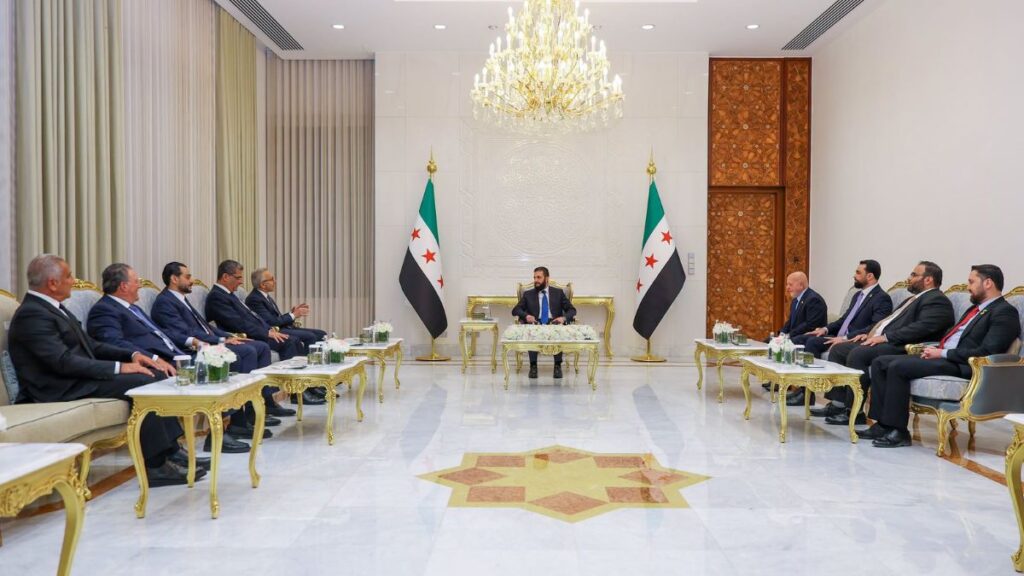
Syria and Lebanon have moved to strengthen economic ties, with the Syrian Ministry of Economy and Industry announcing the signing of a cooperation memorandum on Wednesday, July 15, 2026, in Damascus. This significant agreement, signed between the Federation of Syrian Chambers of Commerce and the Beirut and Mount Lebanon Chamber of Commerce, Industry and Agriculture, occurred during Syrian-Lebanese economic meetings aimed at boosting trade, investment, and cooperation. These discussions in Damascus were central to fostering renewed economic engagement between the two nations. Lebanese Minister of Economy and Trade Amer Bisat visited Damascus with a delegation, meeting Syrian President Ahmed al-Sharaa on Tuesday, July 14, 2026. Syrian Minister of Economy and Industry Mohammad Nidal al-Shaar was present at that meeting, showing the high-level commitment to these bilateral discussions.
During the meeting, President al-Sharaa emphasized that "Syria was seeking economic links with Lebanon rather than military ones, stressing that Syria’s role in Lebanon should be positive and serve the interests of both countries." He noted that "Beirut had historically served as Damascus’s maritime gateway, while Tripoli had served as Homs’s maritime gateway," adding that "the Mediterranean coast had become highly important to supply and distribution chains." A joint Syrian-Lebanese roundtable was also held in Damascus, bringing together economic bodies and private sector representatives to discuss avenues for collaboration. President al-Sharaa stated, "relations between Syria and Lebanon should begin with areas of agreement rather than disagreement, and that Lebanon should benefit from Syria." He concluded, "Syria had begun to emerge as a strategic link between East and West," noting the country's evolving geopolitical importance.
Key Agreements and Discussions
Mohammad Nidal al-Shaar, Syrian Minister of Economy and Industry, indicated that discussions with the Lebanese delegation had established the foundation for practical cooperation across several sectors. Al-Shaar also referenced ongoing efforts to develop mechanisms for exchanging economic information and to establish specialized centers for data collection and analysis. These initiatives are key for building a strong informational infrastructure to support future economic endeavors. Preparations are currently underway to finalize memoranda of understanding between the federations of chambers of commerce and industry in both Syria and Lebanon, signaling a commitment to formalizing broader sectoral cooperation.
Amer Bisat, Lebanon's Minister of Economy and Trade, stated that the Syrian-Lebanese Business Council would function as a permanent platform for dialogue and for monitoring joint initiatives. Bisat affirmed that "the Syrian-Lebanese Business Council would serve as a permanent platform for dialogue and for following up on joint initiatives," ensuring continuous engagement and accountability for collaborative projects. Simultaneously, efforts are being made to remove trade barriers and facilitate the movement of businesspeople between the two countries, aiming to create a more fluid and integrated economic environment.
At the roundtable, two joint cooperation agreements were signed. These were in addition to the cooperation memorandum already established between the Federation of Syrian Chambers of Commerce and the Beirut and Mount Lebanon Chamber of Commerce, Industry and Agriculture. The memorandum provides for developing and encouraging cooperation in trade, alongside various economic and industrial activities, laying a broad foundation for future collaboration.
The agreement also seeks to strengthen relations, communication, and professional ties among chamber members in both nations. This includes fostering direct engagement and networking opportunities. It calls for developing programs and mechanisms designed to expand communication networks between members on both sides, ensuring that businesses can connect and collaborate more easily. The memorandum provides for the exchange of information concerning available commercial opportunities, offering possible trade facilities to streamline transactions, and promoting joint economic events to showcase potential partnerships and investments. These provisions collectively aim to create a more interconnected and mutually beneficial business environment.
Syrian Investment Authority Chairman Talal al-Hilali presented the reforms included in Investment Law No. 114 during the proceedings. Investment Law No. 114 aims to improve the overall investment environment, simplify procedures for investors, and strengthen legal guarantees protecting their interests. These reforms are critical for attracting foreign direct investment and fostering economic growth.
Broader Cooperation Frameworks
The Syrian Ministry of Economy and Industry established the Syrian side of the Syrian-Lebanese Business Council on March 15, 2026, marking a significant step in formalizing cross-border economic dialogue. The council is designed to facilitate ongoing discussions and collaborative initiatives between the two nations' private sectors, serving as a key bridge for business communities. Leadership appointments for the Syrian delegation to this council were also announced, providing a clear structure for its operations.
Leila al-Samman was appointed chair of the Syrian side of the Syrian-Lebanese Business Council, taking a leading role in its operations. Her appointment signifies the importance placed on strong leadership for this key economic body. The appointments also included Ismail Afara and Riyad Abah Ji, who were named vice chairs, providing additional leadership to the Syrian contingent and ensuring diverse perspectives in decision-making. Adib Basatneh was appointed executive director of the Syrian side of the Syrian-Lebanese Business Council, responsible for managing its daily activities and ensuring the implementation of its objectives, from strategic planning to day-to-day operations.
These developments precede a broader governmental agreement. On July 2, 2026, Syrian Foreign Minister Asaad al-Shaibani visited Lebanon, where he signed an agreement establishing the Syrian-Lebanese Higher Committee. This committee is intended to strengthen institutional cooperation and develop bilateral relations, providing a structured framework for high-level engagement between the two governments. The agreement specifies that cooperation will be based on principles of mutual respect, good neighborly relations, and non-interference in internal affairs, aiming to foster a stable and productive relationship built on shared understanding and common goals.
Strategic Vision and Future Outlook
Syrian President Ahmed al-Sharaa has outlined a strategic vision for cooperation, emphasizing economic engagement over military involvement. President al-Sharaa stated, "Syria was seeking economic links with Lebanon rather than military ones, stressing that Syria’s role in Lebanon should be positive and serve the interests of both countries." This statement shows a shift towards prioritizing economic partnership as a cornerstone of bilateral relations. In a June 2026 interview, he noted historical economic connections, noting, "Beirut had historically served as Damascus’s maritime gateway, while Tripoli had served as Homs’s maritime gateway." This historical perspective shows the enduring importance of maritime access to both nations and their long-standing economic interdependence.
Al-Sharaa also pointed to Syria's evolving geopolitical position, asserting, "Syria had begun to emerge as a strategic link between East and West." This vision positions Syria as a vital transit hub, leveraging its geographical location. He explained that the Mediterranean coast's significance for logistics had grown, stating, "the Mediterranean coast had become highly important to supply and distribution chains." This increased importance reflects global trade dynamics and the strategic value of efficient maritime routes. The President stressed the importance of focusing on common ground, remarking, "relations between Syria and Lebanon should begin with areas of agreement rather than disagreement, and that Lebanon should benefit from Syria." This statement frames the current economic initiatives as mutually beneficial endeavors designed to strengthen bilateral ties and foster a shared future of prosperity.