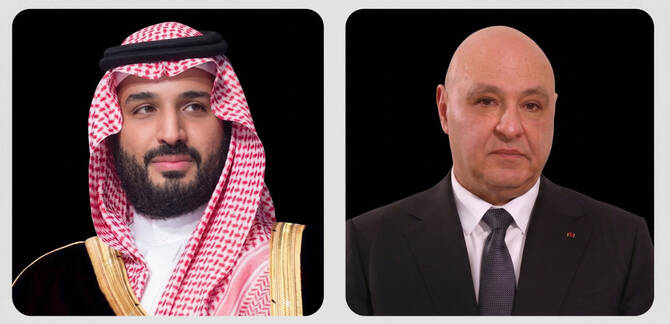
Saudi Crown Prince Mohammed bin Salman received a phone call late Sunday from Lebanese President Joseph Aoun, during which they discussed developments in Lebanon and the broader region. The two leaders also addressed efforts aimed at reinforcing security and stability, according to a report by the Saudi Press Agency. During the call, they specifically discussed the latest developments in Lebanon and the region, alongside concerted efforts to reinforce security and stability across the area. President Aoun conveyed his gratitude for Saudi Arabia's stance on Lebanese affairs, emphasizing the Kingdom's consistent support. "Aoun expressed his deep appreciation for Saudi Arabia’s positions toward Lebanon and its support for efforts to promote stability and peace in the region," the Lebanese President stated. His comments noted Saudi Arabia's backing for initiatives designed to foster peace in the area, showing the deep appreciation for the Kingdom's diplomatic and political engagement. The Saudi Press Agency, the official news outlet of Saudi Arabia, provided a detailed account of the phone call and the key topics addressed by the two prominent leaders, reaffirming the importance of such high-level dialogues in regional diplomacy.
Saudi Support for Lebanon
The phone call between Crown Prince Mohammed bin Salman and President Joseph Aoun showed Riyadh’s continued political backing for President Aoun’s leadership. This support from Riyadh aims to strengthen Lebanon’s state institutions, reinforce its sovereignty, and enhance its overall stability. The Kingdom’s consistent engagement reflects a strategic commitment to a resilient and independent Lebanon. Saudi Arabia has consistently supported President Aoun’s efforts to restore the Lebanese state’s authority across its territory, an objective deemed key for the country's internal cohesion and external standing. This backing is not merely rhetorical; it is part of a broader strategy to empower legitimate state structures against fragmentation or external interference.
Saudi officials have emphasized the importance of the full implementation of the Taif Agreement, a cornerstone of Lebanon's political structure that ended the civil war and established the current power-sharing arrangement. The full and faithful adherence to this agreement is seen by Saudi Arabia as vital for maintaining internal balance and preventing renewed conflict. The Kingdom has noted the significance of adhering to relevant international resolutions concerning Lebanon, which often address issues of sovereignty, territorial integrity, and the presence of non-state armed actors. A key aspect of Saudi Arabia's position is its insistence on the exclusive possession of arms by the Lebanese state, reinforcing the state's monopoly on legitimate force. This principle is considered fundamental for any sovereign nation and is consistently advocated by Riyadh as essential for Lebanon's long-term security and stability. Saudi Arabia has consistently supported efforts to preserve Lebanon’s sovereignty and territorial integrity, viewing these as essential for regional stability and for Lebanon to chart its own course free from undue influence. The Kingdom's commitment extends to ensuring that Lebanon can manage its internal affairs effectively and maintain its status as a sovereign nation.
Regional Peace Efforts
Riyadh has backed Lebanon's efforts to pursue a negotiated path aimed at ending hostilities with Israel. This support aligns with Saudi Arabia's broader regional foreign policy objectives, which prioritize de-escalation and diplomatic solutions to long-standing conflicts. Saudi Arabia has also supported Lebanon's initiatives to restore stability along the border between the two countries, recognizing the critical importance of secure and peaceful borders for regional tranquility. These initiatives are seen as vital steps towards reducing tensions and preventing further escalation in a volatile region. For his part, Lebanese President Joseph Aoun has called for direct talks with Israel to resolve the conflict, expressing a clear desire for a diplomatic resolution. President Aoun's proposals include securing an Israeli withdrawal from Lebanese territory, a key demand rooted in international law and Lebanese national interests. He has further advocated for establishing arrangements that would support a lasting cessation of hostilities, aiming to move beyond temporary ceasefires to a more permanent state of peace and security. Saudi Arabia has consistently supported diplomatic efforts designed to end violence in the region, viewing dialogue and negotiation as the most effective means to achieve sustainable peace and stability. The Kingdom's diplomatic channels are often utilized to encourage such initiatives and foster an environment conducive to peaceful resolutions.
Broader Context and Significance
The recent discussions between Saudi Crown Prince Mohammed bin Salman and Lebanese President Joseph Aoun take place amidst ongoing regional challenges, including persistent geopolitical tensions and economic uncertainties affecting various nations. The broader context of these exchanges includes Saudi Arabia's longstanding financial and political engagement with Lebanon, a relationship that has spanned decades and weathered numerous regional upheavals. Historically, Saudi Arabia has been a significant donor to Lebanon, providing aid and investment to support its economy and stability during critical periods. This financial backing has been a consistent feature of the relationship, particularly during periods of economic hardship in Lebanon, demonstrating a tangible commitment to the country's welfare. The Kingdom's support often aims to bolster Lebanese state institutions and mitigate external influences that could destabilize the nation.
The current dialogue reinforces Saudi Arabia's commitment to a stable Lebanon, especially as the country navigates complex internal dynamics and regional tensions that continue to pose significant challenges. Saudi Arabia views a strong and independent Lebanon as key for the overall balance of power and stability in the Levant. The Kingdom maintains a keen interest in Lebanon's sovereignty and its capacity to manage its own affairs without undue interference from other regional or international actors. This commitment is not merely altruistic but is rooted in a strategic understanding that a stable Lebanon contributes to the wider security architecture of the Middle East. Saudi Arabia's diplomatic efforts have consistently sought to promote peace and de-escalation in the wider region, reflecting a broader strategy to foster stability and economic prosperity across its immediate neighborhood and beyond. The phone call between Crown Prince Mohammed bin Salman and President Joseph Aoun serves as a reaffirmation of these enduring ties and shared objectives, noting the importance of continued high-level communication in addressing complex regional issues. The discussions touched upon various aspects of bilateral relations and regional developments, reflecting a full approach to fostering peace and security. The continuity of such dialogues is critical for maintaining open channels and coordinating responses to emerging challenges, solidifying a relationship that has been vital for both nations.