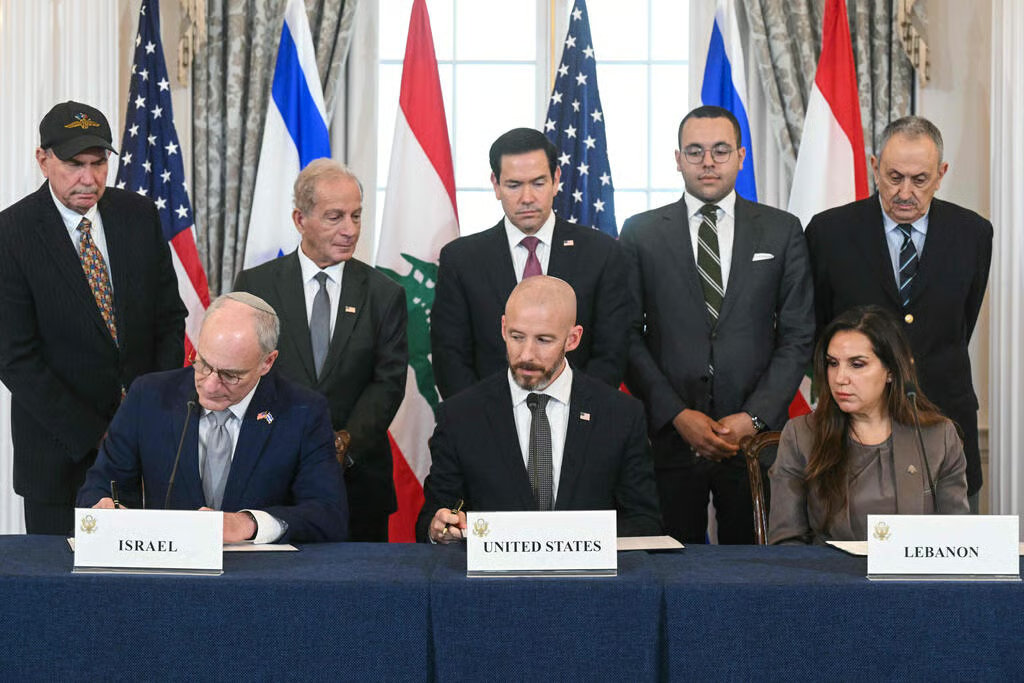
An agreement between Lebanon and Israel was signed this evening, Friday, at the U.S. State Department. This significant diplomatic accord marks a key moment in the complex relationship between the two nations. The deal represents a framework for future relations and aims to address long-standing issues that have historically fueled regional instability. The signing ceremony took place in Washington D.C. Bringing together representatives from both nations under American mediation, showing the United States' role in facilitating this breakthrough. This agreement is viewed as a key step towards de-escalation and the establishment of more stable conditions along their shared border.
Key Principles and Conditions
Washington understandings establish several key principles for the brokered framework. These principles include a mutual recognition between Lebanon and Israel, the separation of Lebanon from Iran, and a non-automatic Israeli withdrawal. The Israeli withdrawal is conditioned specifically on Hezbollah’s disarmament. This condition notes the persistent security concerns that have long dominated the discourse between the two countries. The framework aims to lay the groundwork for a more secure and predictable future, contingent on the fulfillment of these critical stipulations.
Israel, through its recognition of Lebanese sovereignty, effectively states that it will evacuate its forces from the area and withdraw to the international border once the threat originating from southern Lebanon is eliminated. This commitment is central to the framework's objective of establishing a lasting peace. However, this withdrawal is not unconditional. If southern Lebanon is not cleared of Hezbollah’s military presence, encompassing both heavy and light weaponry, Israel retains its entitlement to maintain the security zone it presently controls. This provision shows the conditional nature of the agreement and Israel's continued focus on its security interests. The presence of Hezbollah's arsenal in southern Lebanon has been a long-standing point of contention, and its disarmament is presented as a prerequisite for Israel's full withdrawal.
Border Disputes and Sovereignty
The first principle emerging from the agreement establishes mutual respect for sovereignty. This foundational element is central to the framework deal brokered by the United States, aiming to create a basis for peaceful coexistence. The agreement emphasizes that both nations acknowledge and respect the territorial integrity and independence of the other. This mutual recognition is a significant diplomatic achievement, providing a formal basis for engagement. Israel would also be prepared to discuss with the Lebanese government the 13 disputed points along the frontier. These points represent areas of contention regarding the precise demarcation of the border between the two nations, which have historically been a source of tension. The willingness to engage on these specific issues indicates a move towards resolving long-standing territorial disagreements within the broader framework agreement, potentially leading to a more clearly defined and respected international boundary.
Past Failures and Skepticism
The current framework agreement faces skepticism due to past failures and conditional clauses. In this agreement, Hezbollah loses the legitimacy it claims as the "defender of Lebanon," a narrative it has long employed to justify its military presence. Israel’s withdrawal from southern Lebanon is conditional on Hezbollah not returning to the area and on the disarmament of the region from Hezbollah’s weapons. Israel is not committing—neither in principle nor in practice—to withdraw from the security zone it currently holds in southern Lebanon if these conditions are not met. These conditions evoke memories of previous diplomatic efforts that ultimately faltered. United Nations Security Council Resolution 1701, which ended the Second Lebanon War, largely became a dead letter, noting the challenges of enforcing such agreements in the past and fueling concerns about the long-term viability of this new framework. The success of this agreement will depend heavily on the political will of all parties to uphold its terms and ensure compliance with the stipulated conditions.