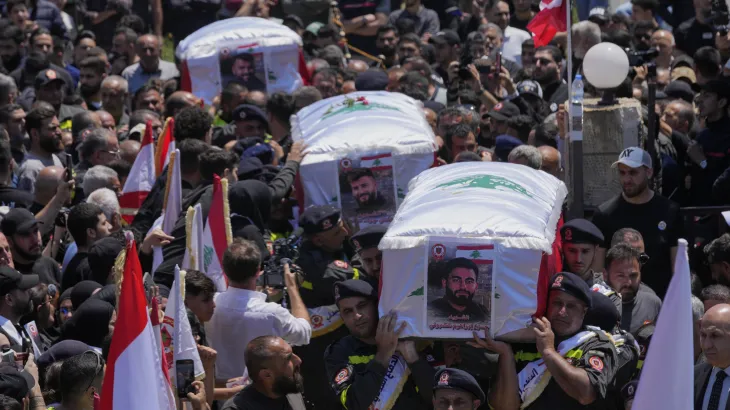
Israeli warplanes conducted air strikes on the town of Qlawiyah in Lebanon’s Bint Jbeil district, hitting a vehicle convoy and killing one person, according to reports. Lebanon experienced its deadliest day in the renewed conflict between Israel and the Iranian-backed Hezbollah militant group on Thursday, reeling from the intense escalation. The total number of those killed by Israeli attacks in Lebanon today reached at least 28, NNA reports indicated.
An Israeli air strike in Jebchit, located in Lebanon’s Nabatieh district, killed four people, including two children and a woman, and wounded nine others, among them three children and four women. Heavy Israeli air strikes were reported across dozens of towns in southern Lebanon on Sunday, including in Bint Jbeil. Since fighting renewed on March 2, Israeli attacks have killed 2,055 people, with 167 fatalities recorded since Friday. In response to the ongoing hostilities, missile interceptions also occurred in northern Israel.
Escalating Violence in Lebanon
Israeli forces in southern Lebanon are reportedly "clearing" a vast area encompassing 60 Lebanese villages, according to claims. Lebanon’s National News Agency reported an Israeli drone attack in Zebdine killed six people. An Israeli raid also injured two people in the town of Dibbine, as Israeli attacks continued across the region. Israel's announcement of clearing operations came hours after it had warned of escalation and stated it had killed Ali Yusuf Harshi, an aide and nephew of Hezbollah leader Naim Kassem.
Israeli strikes on Wednesday killed at least 203 people and wounded more than 1,000 without prior warning, Lebanon’s health ministry stated. Israel’s military said it targeted Hezbollah sites, but several strikes hit densely packed commercial and residential areas during rush hour, leading to widespread civilian casualties. Lebanese President Joseph Aoun called the attacks "barbaric." Lebanese Prime Minister Nawaf Salam further condemned the actions, stating his country will file an urgent complaint with the U.N. Security Council, calling the attacks a “blatant violation” of international and humanitarian law.
The violence has resulted in significant civilian losses, with Mohammad Chehab, a Syrian man from Deir el-Zour, stating that six of his 10 family members had been found dead in a destroyed building. Abdul Rahman Mohammad, another Syrian, waited at Rafik Hariri Hospital to retrieve the bodies of his mother, two sisters, brother, and brother-in-law. Mohammad stated, "They were struck without any warning. This is Israeli brutality." A man was also found alive in his collapsed apartment building in the southern suburbs, noting the widespread destruction.
At the Makassed hospital, Rabee Koshok received treatment after being in the commercial district of Corniche al Mazraa when a strike hit a nearby building. Koshok recounted, "I thought I was dead. What happened? A big flash of light struck my face and eyes, and I found someone flying over and landing next to me. He was dead." Dr. Wael Jarrosh, also at Makassed hospital, reported that the facility received around 70 injured patients within 10 minutes of the blasts. Dr. Jarrosh added, "This has destroyed us psychologically." Two people died and five remained hospitalized at Makassed hospital, including three in intensive care, showing the severity of the injuries.
Hezbollah's New Tactics and Israeli Response
Rafi Milo, commander of Israel’s Northern Command, stated that Israeli forces have pushed 10 kilometers (6.2 miles) into Lebanese territory. Milo also affirmed that Israeli forces “do not intend to pull back from the line. What we’re doing is significant, and we still have much to do.” He added, "In our sector, we have full freedom of action — we are operating, striking, firing," and acknowledged, "We are aware of the public mood on the home front — this is a long war."
Hezbollah has reportedly deployed fiber-optic-guided drones, which are designed to bypass electronic defenses, using them against Israeli troops in southern Lebanon and near the border. Fighting renewed on March 2 following a Hezbollah attack on Israel. Since then, 12 Israeli soldiers and two civilians have been killed by Hezbollah. Israel's Prime Minister Benjamin Netanyahu stated that the war continues, including in the security zone in Lebanon. Netanyahu added, "We have thwarted the threat of an invasion from Lebanon thanks to this security zone." Israel had previously announced a security buffer zone extending eight to 10 kilometers (five to six miles) inside Lebanese territory.
The Israel Defense Forces (IDF) claimed that troops killed more than 20 Hezbollah fighters operating from a hospital compound in Bint Jbeil. However, Lebanon's health ministry denied the IDF claim, accusing Israel of targeting civilians and medical facilities. In a separate development, a wounded woman was found alive overnight in the seaside neighborhood of Ain Mreisseh. Israel also made a surprise announcement authorizing direct talks with Lebanon, despite the two nations lacking formal diplomatic ties. These talks, according to Israeli Prime Minister Benjamin Netanyahu, would focus on disarming Hezbollah and “establishing peaceful relations” between the countries. However, Hezbollah has rejected this initiative for talks, and Israel's embassy in Washington has stated it will not discuss a ceasefire with Hezbollah. Lebanese, Israeli and US officials are nonetheless due to hold talks in Washington on Tuesday.
International Reactions and Diplomatic Efforts
FIFA’s President Gianni Infantino announced Iran’s participation in the FIFA World Cup 2026, stating, "Let me start by the outset, confirming straightaway that of course Iran will be participating at the FIFA World Cup 2026. And of course, Iran will play the United States of America." Iranian President Masoud Pezeshkian, however, characterized the US naval blockade on Iranian ports as “an extension of military operations.” Pezeshkian asserted that the continuation of this approach is “intolerable,” adding, "Continuation of this oppressive approach is intolerable." He also stated that Iran is "paying the price for its resistance and independence." U.S. Vice President JD Vance on Wednesday said Washington asked Israel to scale back attacks on Lebanon to ensure negotiations with Iran are successful.
Separately, Italy condemned Israel’s interception of aid ships bound for Gaza. Italy demanded the release of its citizens, who it claimed were “unlawfully detained” during the operation near Crete. Organisers from the Global Sumud Flotilla described the interception as piracy. Germany and Italy subsequently issued a joint statement expressing “deep concern” and urging “full respect of international law.”
Regarding Iran, Israeli Defence Minister Israel Katz stated his country may have to “act again” against Iran. Katz affirmed that US President Donald Trump, in coordination with Prime Minister Benjamin Netanyahu, is leading efforts to ensure Iran does not become a threat. Katz added, "We support this effort and are providing the necessary support, but it is possible that we may soon have to act again to ensure these objectives are met."
Humanitarian Crisis and Displacement
Around 1.2 million people are displaced across Lebanon, with more than 200,000 having fled into Syria since the war resumed. The health ministry reported the death toll in Lebanon has reached 1,739, with 5,873 wounded. Reports indicated that Taleen Saeed, just under two years old, was killed when a strike hit during her father's funeral, with her seven-year-old sister, Aline, badly burned and hospitalized. Their grandfather, Nasser Saeed, 63, stated, "This isn't humanity. This is a war crime," and asked, "Where are the human rights? If a child - a child - is wounded in Israel, the whole world jumps up. Are we not people? Are we not humans? We're like them!"
A Lebanese Red Cross rescuer was reportedly "directly targeted by an Israeli drone" and killed while on a humanitarian mission, according to the Lebanese Red Cross. Lebanese authorities report more than 80 rescuers and medical personnel have been killed in Israeli strikes since the start of the war. Dr. Mohamad El Zaatari, director of the public hospital, said it had treated 45 injured people, including 10 in intensive care. Melhem Khalaf, a reformist legislator representing Beirut, stated, "All the targeted areas are safe residential Lebanese areas... What we are witnessing is a massacre against civilians." Iran’s parliament speaker, Mohammad Bagher Qalibaf, had earlier warned that continued Israeli attacks would bring "explicit costs and STRONG responses," while insisting that a two-week ceasefire in the Iran war extended to Lebanon. Hassan Nasrallah, the group's late leader, was killed by Israel in 2024, reports indicated. The United Nations Interim Force in Lebanon (Unifil) reported Israeli tanks rammed two peacekeeping vehicles on two separate occasions, further escalating tensions. The Lebanese government announced a plan to demilitarize Beirut and deploy larger numbers of security patrols. The main border crossing between Lebanon and Syria returned to service Thursday, five days after the Israeli military warned of plans to strike it, alleging that Hezbollah was using it to smuggle military equipment. Tens of thousands are also displaced in northern Israel due to the ongoing conflict. Lebanon's Prime Minister Nawaf Salam stated that efforts to end the conflict are continuing.