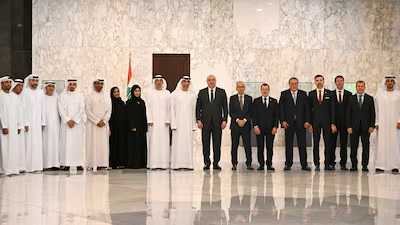
The United Arab Emirates pledged support for Lebanon's economic development on the final day of a business forum held in Beirut. This significant commitment follows a series of high-level discussions specifically aimed at strengthening partnerships and fostering closer economic ties between the two nations. The forum served as a key platform for dialogue and collaboration, marking a renewed emphasis on bilateral relations. During the forum, Dr Thani Al Zeyoudi, the UAE's Minister of Foreign Trade, met with Lebanese President Joseph Aoun in Beirut. This high-level meeting showed the UAE's renewed and strong interest in contributing to Lebanon's economic stability and growth, signaling a strategic shift in engagement. The direct interaction between such senior officials notes the importance both countries place on this burgeoning partnership. The engagement signals a collaborative effort to explore avenues for mutual benefit and to enhance trade relations, moving beyond previous periods of strained diplomatic ties. The discussions focused on identifying key sectors for investment and cooperation, aiming to lay a solid foundation for future economic projects.
Business Forum Notes and Collaborative Agreements
The recent business forum facilitated a "new wave of private-sector partnerships," according to state news agency Wam, indicating a significant upturn in commercial engagement. The event saw a substantial commitment from the UAE, with an 80-member UAE delegation visiting Lebanon specifically for the event. This large delegation comprised representatives from various sectors, showing the breadth of interest in Lebanese markets. The intensive two-day forum was highly productive, resulting in the signing of four distinct agreements designed to cement future cooperation. These agreements are expected to provide a structured framework for ongoing economic interaction and investment.
One key agreement formally established a UAE-Lebanon Business Council, specifically designed to foster ongoing economic cooperation and facilitate dialogue between the business communities of the two nations. This council is anticipated to be a key mechanism for identifying opportunities, resolving trade issues, and promoting joint ventures. A second key agreement was signed to link the chambers of commerce in Abu Dhabi and Beirut, aiming to streamline trade and investment activities by creating direct channels for communication and collaboration between enterprises. This linkage is expected to reduce bureaucratic hurdles and enhance efficiency in cross-border business dealings.
Further solidifying the private sector's role, UAE-based Elite Agro Holding signed two distinct agreements during the forum. The first agreement involved a collaboration for farming research with the American University of Beirut, indicating a focus on agricultural innovation and sustainable practices. This partnership is expected to leverage academic expertise to develop advanced farming techniques applicable to Lebanon's agricultural sector. The second agreement saw Elite Agro Holding partner with Georges Daccache & Sons for the design of agricultural greenhouses, a move that could significantly boost Lebanon's food security and agricultural output through modern infrastructure. Businesses from the UAE representing various key sectors, including health, energy, aviation, tourism, and artificial intelligence, also actively participated in the forum, showcasing the diverse areas of potential investment and partnership. Their presence notes the full approach the UAE is taking to support Lebanon's economic recovery and development across multiple fronts.
Economic Ties and Trade Growth
The United Arab Emirates reaffirmed its unwavering commitment to supporting Lebanon’s stability, sovereignty, and economic development. This pledge shows a broader, long-term effort to deepen bilateral relations and ensure a resilient partnership between the two nations. The renewed commitment from the UAE is seen as a key step towards bolstering Lebanon's economic resilience in the face of ongoing challenges. The economic relationship between the UAE and Lebanon has shown significant growth in recent periods, reflecting a positive trajectory in their commercial exchanges. This upward trend is indicative of increasing confidence and investment flows between the two countries.
The volume of non-oil trade between the UAE and Lebanon reached an impressive $4.2 billion last year, marking a substantial increase in commercial exchange. This figure represented a notable rise, as the trade volume was more than a third higher than in the previous year, 2024. The significant year-on-year increase in trade activity notes strengthening economic links and diversification efforts between the two countries, moving beyond traditional sectors. This expansion in trade is a testament to the growing demand for goods and services in both markets and the efforts made to facilitate easier commerce. The diversification of trade also suggests a maturing economic relationship, exploring new avenues for mutual benefit.
Further signaling a normalization and enhancement of relations, the UAE lifted a ban on Emiratis traveling to Lebanon in June. This decision was a significant diplomatic gesture, removing a key impediment to deeper ties. The removal of travel restrictions is expected to facilitate increased business and tourism flows, thereby contributing substantially to Lebanon's economy and fostering greater people-to-people connections. The influx of tourists and business travelers from the UAE is anticipated to provide a much-needed boost to Lebanon's hospitality and service sectors. These developments collectively indicate a renewed focus on economic partnership and strong support from the UAE for Lebanon, aiming to assist the country in its path toward recovery and sustainable growth. The full nature of these engagements, from high-level meetings to private sector agreements and the lifting of travel bans, paints a clear picture of a revitalized bilateral relationship.
Lebanon's Broader Challenges and International Support
Lebanon faces substantial economic needs following years of conflict between Israel and Hezbollah, a major financial crisis that has crippled its banking system, and the devastating 2020 Beirut port explosion, which compounded existing hardships. The country's economy has struggled immensely to recover amidst these compounding and multifaceted challenges, leading to widespread social and economic distress. The financial crisis, in particular, has seen the national currency plummet, eroding savings and purchasing power for ordinary citizens. Adding to the instability, Israeli attacks on Lebanon have continued despite a tenuous ceasefire being in place, creating an unpredictable and dangerous security environment. These ongoing hostilities contribute to an uncertain environment for economic recovery and investment, as businesses are reluctant to commit capital in a volatile region. The constant threat of escalation deters both domestic and foreign investment, further hindering growth prospects.
Amidst these complex and deeply entrenched circumstances, the United States recently brokered a framework agreement between Israel and Lebanon. This diplomatic initiative aims to establish a basis for future negotiations, potentially addressing some of the long-standing issues contributing to regional tensions and instability. The agreement represents an effort to de-escalate tensions and provide a pathway for more durable peace in the region. The diplomatic effort shows the international community's recognition of the deep-seated challenges Lebanon faces, acknowledging that economic recovery is inextricably linked to regional stability. The economic and security landscape remains precarious, with the country navigating multiple crises simultaneously, including political paralysis, humanitarian concerns, and the ongoing repercussions of past conflicts. The support from the UAE, alongside international diplomatic efforts, is critical in providing Lebanon with the necessary resources and stability to begin rebuilding its economy and society.