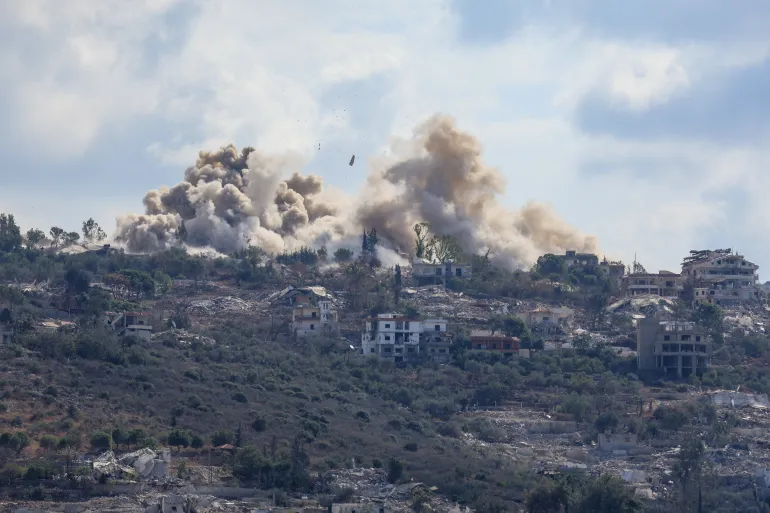
Israel currently occupies a zone stretching up to 10 kilometres deep into southern Lebanon, where approximately 50 frontline villages have been destroyed. More than 1.2 million people have been displaced by Israeli attacks and the reinvasion of southern Lebanon. Mohamad Bazzi, a New York-based political analyst, stated: "Israel’s primary goals were to empty, depopulate, and make those dozens of frontline villages and towns uninhabitable, and we’ve seen that now with the satellite imagery. It was a way of applying that Gaza model to Lebanon." Ali, a displaced resident from Khiam, remarked: "Southerners are living a tragedy. This is all from flawed tragedies and failed politics." He added: "Khiam is destroyed, there’s nothing, it’s uninhabitable for the next 10, 15, 20 years. They returned us to the Stone Age."
Destruction of Frontline Villages
Hezbollah launched rockets at Israel on 2 March 2026. The group stated the strikes occurred in response to daily violations of the November 2024 ceasefire and the assassination of Iran's Supreme Leader Ayatollah Ali Khamenei.
Lebanon and Israel subsequently signed a framework agreement in June 2026. This pact was designed to facilitate a phased Israeli withdrawal from the occupied zone. The agreement intended to establish conditions for the return of displaced populations to their homes in southern Lebanon. These developments followed months of military activity along the border, during which both parties sought to manage the security situation through diplomatic channels. The June accord represented an attempt to formalize the end of hostilities that had intensified earlier in the year.
Defining the Yellow Line
Discussions within Israel regarding the potential creation of a "Grey Line" have emerged, proposing a buffer zone that could extend 4 kilometres into Lebanese territory. Reports indicate that this zone would function as a formalised security barrier. Alongside these proposals, Israeli Defence Minister Israel Katz has suggested an extended occupation of southern Lebanon, drawing comparisons to the 22-year military presence that concluded in 2000.
Ahmad Baydoun, a Lebanese architect and open-source researcher, observes that the current demarcation functions as a permanent barrier. "[The Yellow Line] is treated as a hard boundary, both in terms of troop presence and the controlled demolition of villages, which continues unabated despite the ceasefire," Baydoun stated. "It is as if the ceasefire applies to the rest of Lebanon but not to this territory."
Local officials have expressed concern over the designation of specific areas for these military measures. Hasan Bazzi, the president of Froun’s municipal office, addressed the impact on local communities during the ongoing operations. "We were surprised that it was [included as a] pilot zone," Bazzi said.
The integration of these zones remains a point of contention as the military presence persists in the border region. These administrative and physical divisions continue to shape the daily reality for residents of southern Lebanon, despite the existence of the June 2026 framework agreement. The reported plans for a Grey Line and the suggestion of a long-term occupation by Israel Katz indicate a shift in the security posture along the border.